
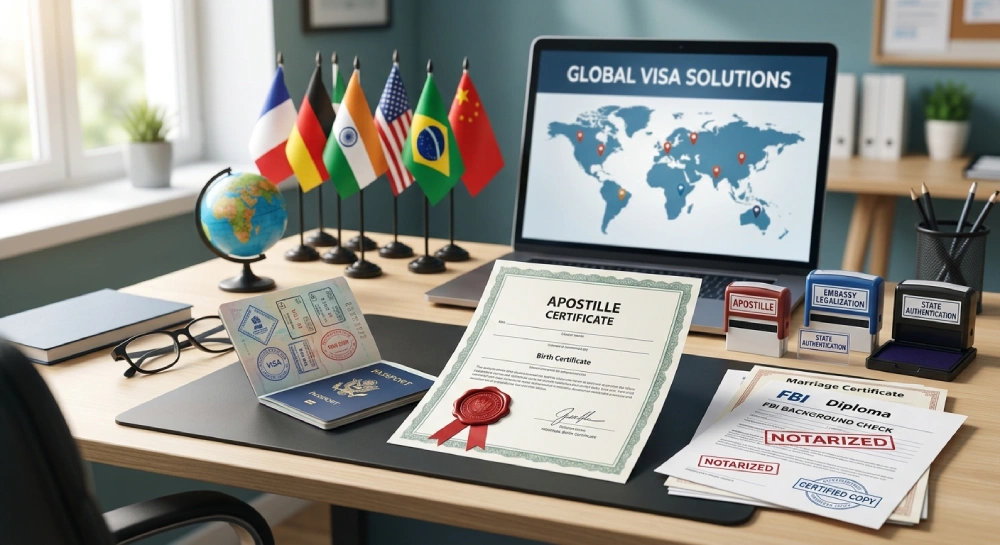
Applying for a visa often means providing official documents from your home country—birth certificates, marriage certificates, diplomas, or police clearances. But here is the thing. The country you are applying to needs to know those documents are genuine.
That is where authentication and legalization of documents and list of documents that can be apostilled comes in.
Apostille vs. Legalization: Two Different Paths
The process of authentication of documents depends entirely on whether your destination country is part of the Hague Apostille Convention. If both countries are members, you go through a streamlined process called an apostille. If not, you go through a longer, multi-step process called legalization.
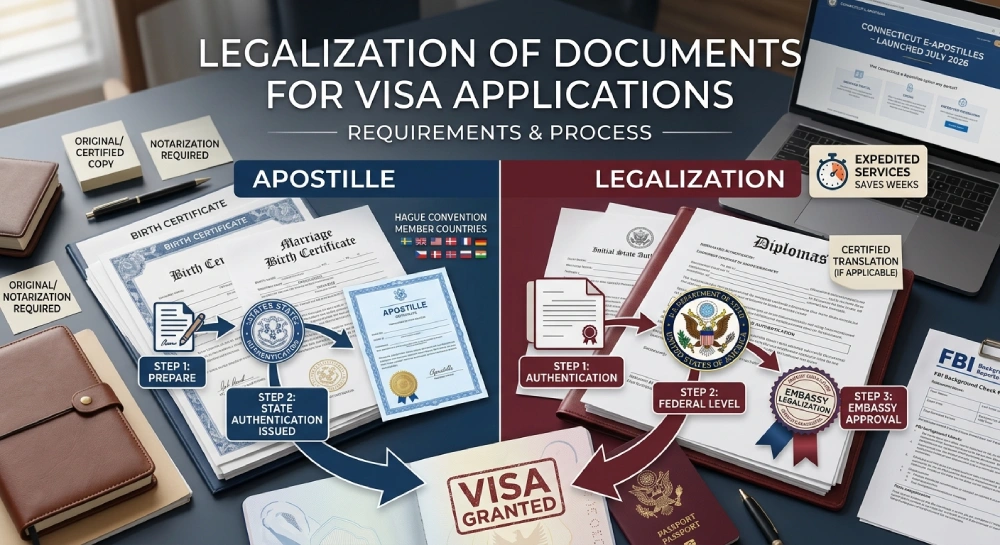
Apostille: This is a simplified certification recognized in over 120 countries that have signed the Hague Convention . It is a single certificate issued by a designated authority in the country where the document was issued. No further authentication is needed once the apostille is applied.
Authentication and Legalization. For countries that are not part of the Hague Convention, the process involves two steps. First, the document is authenticated by the issuing authority (state or federal). Then, it must be legalized by the embassy or consulate of the destination country.
If you choose the wrong path—apostille for a non-Hague country, or legalization for a Hague country, your legalization of documents will be rejected .
The Apostille Process: Step-by-Step
- Prepare your document: Ensure it is an original or a certified copy. It must be notarized or certified by the appropriate official authority within the last 10 years.
- Submit to the correct authority: In the U.S., for example, state-issued documents go to the state Secretary of State. Federal documents go to the U.S. Department of State. Many states now allow you to apply online.
- Receive the apostille: The authority attaches the apostille certificate to your document. Processing times vary. Connecticut processes regular orders within 5 to 7 business days but offers 24-hour expedited service.
The Legalization Process: When the Apostille Isn’t Enough
The legalization of documents is the final step for going to countries that do not accept apostilles.
Step 1: Authentication.The document is first authenticated by the issuing authority (state or federal government). This verifies the signature and seal of the official who signed it.
Step 2: Embassy Legalization. The authenticated document is submitted to the embassy or consulate of the destination country. The embassy stamps or seals it, giving it official consular approval . This step can take days or weeks, depending on the embassy’s workload.
Which Documents Can Be Legalized or Apostilled?
- Vital records – birth, marriage, and death certificates
- Education documents – diplomas and transcripts
- Background checks – FBI reports and police clearance certificates
- Legal documents – powers of attorney and court rulings
- Business documents – certificates of incorporation, articles of organization
The following is a list of some common documents that may need apostille or authentication.Here are some common documents that may require apostille or authentication.
Common Documents That Require Apostille or Authentication
One of the most frequent requests for those using U.S. vital records abroad is an apostille birth certificate.Apostille birth certificates are one of the most frequent requests for use of U.S. vital records abroad, especially for immigration, marriage, residency, or citizenship. Other commonly requested documents are an FBI background check apostille (the FBI Identity History Summary) for use in a Hague Convention country. The applicant might be required to provide additional certification depending on the country of origin and the type of document.
Incorporation documents, powers of attorney, court records, diplomas, or other incorporation documents may be needed for international use for businesses and individuals. When in doubt regarding what type of certification your document may need, you can have the document authenticated. The purpose of document authentication services is to certify the signature, seal or authority of a document for acceptance by the foreign government or institution receiving it.
Key Requirements to Know For Legalization OF Documents
The document must be original or a certified copy. It cannot be a photocopy. It must be notarized or certified by the correct authority. The destination country determines which path you take. If a country is not a Hague member, legalization is mandatory.
For visa applications, both apostilles and legalization must be completed before submitting the visa application. You cannot add legalization later . If your document is in a language other than the official language of the destination country, you will need a certified translation .
- Expedited Options
Standard apostille processing takes several business days to a few weeks. If you are in a hurry, many service providers offer expedited apostille service, sometimes with next-day options . Expedited services cost more but can save you weeks if your visa application is time-sensitive.
Conclusion
Legalization of documents is a critical step in the visa application process. The key is knowing which process applies to your documents based on the destination country. For countries in the Hague Convention, the apostille process is quick and straightforward. For others, the full legalization process is required. Start early, use the correct procedures, and your documents will be ready for your visa application.
Frequently Asked Questions
What is the difference between an apostille and legalization?
An apostille is a simplified certification for documents going to countries that are members of the Hague Apostille Convention. Legalization is a two-step process for non-Hague countries: authentication by the issuing authority, followed by consular approval from the destination country’s embassy.
How do I know if my destination country accepts apostilles?*
Check the list of countries that have ratified the Hague Apostille Convention. Over 120 countries, including France, Germany, India, Turkey, and China, are members. If your destination is not on the list, you will need to go through authentication and legalization instead
Can I get documents apostilled online?
Yes. Many countries and U.S. states now offer online apostille application systems. For example, Connecticut launched e-Apostilles in July 2026, allowing electronic submission and digital issuance. You can typically upload your document, pay online, and receive the apostille by mail.
How long does document legalization take?
Apostille processing can take 5 to 7 business days for regular orders, or as little as 24 hours for expedited service in some jurisdictions.
What is an FBI background check apostille?
This is a U.S. federal document (FBI Identity History Summary) that has been authenticated with an apostille for use in Hague Convention countries.