
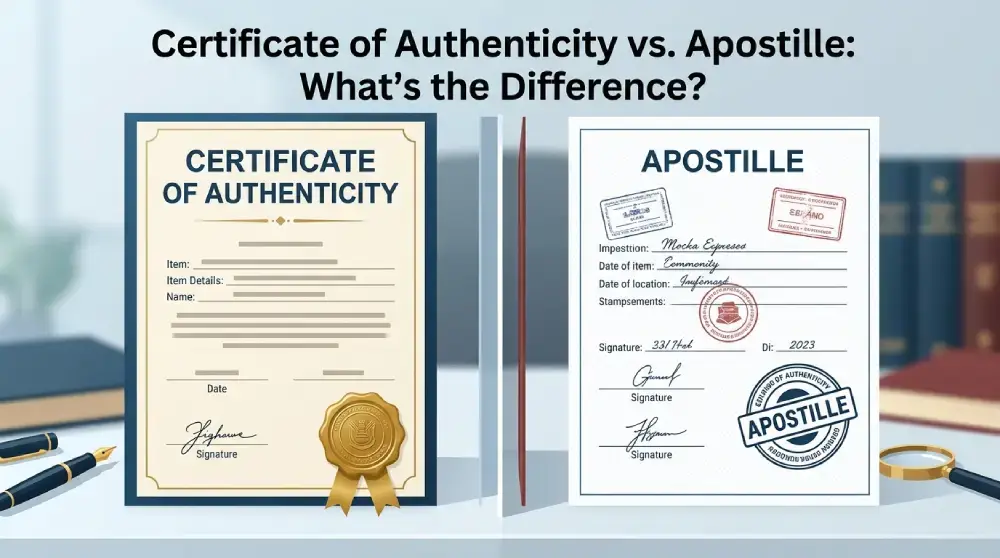
When preparing documents for international use, terms like certificate of authenticity, apostille, and certificate of authentication can be confusing. Although they all relate to verifying documents, they serve different purposes. Choosing the correct process depends on the document, the country where it was issued, and the country where it will be used.
For example, someone preparing an Overseas Citizen of India (OCI) application from the United States may need specific documents authenticated or apostilled, depending on the document and current consular requirements. Understanding the difference can help prevent delays and unnecessary paperwork.
What Is a Certificate of Authenticity?
A certificate of authenticity generally verifies that an item or document is genuine. The exact meaning depends on the context. For artwork or collectibles, it may confirm that an item is authentic. In document legalization, however, people sometimes use the term when referring to official certification or authentication.
A certificate of authenticity is not automatically the same as an apostille. If you need to submit a birth certificate, marriage certificate, or other official record abroad, check which form of verification the receiving authority requires before arranging certification.
What Is an Apostille?
An apostille is an official certificate that verifies the origin of a public document, such as the authenticity of a signature, the capacity in which the signer acted, and the identity of a seal or stamp. It does not certify that every statement in the document is factually true.
Under the Hague Apostille Convention, participating countries accept apostilles as a simplified alternative to traditional legalization for documents covered by the convention. This can reduce the number of government offices involved when preparing eligible documents for international use.
Common documents that may require an apostille include birth certificates, marriage certificates, court records, and certain educational documents. The exact procedure depends on the issuing authority and destination country.
Certificate of Authentication vs. Apostille
A Certificate of Authentication is actually part of a document-verification procedure that is normally utilized when a document requires additional authentication for international use. It may require the involvement of the state authorities or the U.S. Department of State or a foreign embassy or consulate, depending on the country and document.
The only distinction is the requirements of the country that is a destination. If the Hague Apostille Convention applies, an apostille might be enough. If it does not apply, it may be necessary to use traditional authentication and consular legalization.
Prior to beginning, verify the requirements with the authority to whom you are submitting your document. The incorrect process will result in rejection or delays.
Apostille for Birth Certificate and Marriage Certificate
An apostille might be required for a birth or marriage certificate in certain situations, such as when it is presented to a foreign government or for an immigration document. Requirements vary according to the issuing and presenting locations of the certificate.
Apostille for Birth Certificate
An apostille for birth certificate documents can help verify an eligible public record for international use. Typically the first step is to acquire an acceptable official or certified birth certificate from the relevant records office in the United States. The other State will then decide what steps are necessary to certify the document to be presented for an apostille.
Ensure that the certificate is a suitable recipient for the authority. An unofficial certified record could not be accepted as a substitute for an official record from a hospital.
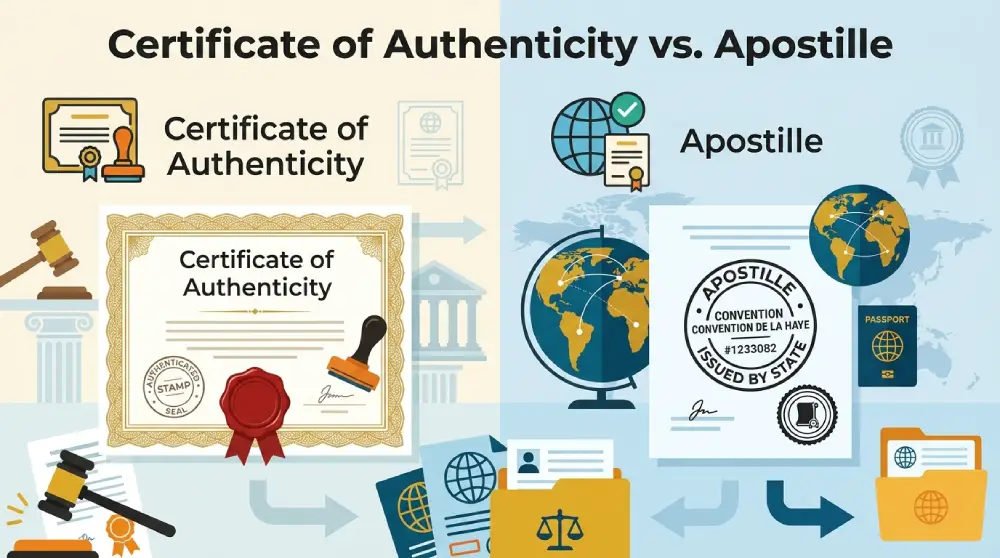
Apostille for Marriage Certificate
An apostille for marriage certificate documents follows a similar process, but requirements can vary by state. An official marriage record, verification from issuing authority or other certification may be required before an apostille can be issued.
If it is to be used for an Immigration Application, make sure that the Immigration authority also requires a translation, some form of identification or supporting documents.
Apostille and Authentication for an OCI Application From the USA
People applying for an Overseas Citizen of India card may need to submit documents proving identity, family relationships, or eligibility. The exact OCI document requirements depend on the applicant’s circumstances and the category of application.
For an OCI application from USA, documents issued by U.S. authorities may require an apostille or other verification, depending on the document and the current instructions. India’s official OCI guidance explains that certain foreign-issued birth and marriage certificates must be apostilled or certified by the appropriate authority.
Before submitting an Overseas Citizen of India application, review the current official checklist for your application category. Do not assume every document needs the same certification or that an apostille replaces all other application requirements.
Before requesting a certificate of authenticity, confirm which country will receive the document.
Conclusion:
If you want to prepare documents for international use, you will need to understand the difference between a certificate of authenticity, an apostille and a Certificate of Authentication. These terms are associated with verification but are not necessarily synonymous. By doing so, you can avoid rejected documents, penalties, and delays.
Frequently Asked Questions
Is a certificate of authenticity the same as an apostille?
No. There are various types of verification that may be included in a certificate of authenticity. An apostille is an international certificate that is used for authenticating eligible public documents.
What is the difference between apostille and authentication?
An apostille is generally used for eligible documents going to countries covered by the Hague Apostille Convention. An authentication certificate is generally used when the destination requires traditional authentication and may require further consular legalization.
What does a Certificate of Authentication verify?
It is usually used to confirm the signature or seal on a document, or to confirm that the document is authentic. It does not automatically validate the information within the document.
Does a birth certificate need an apostille?
It will depend on the requirements of the destination country and the type of document. Investigate if an apostille or authentication or other type of certification is needed by the receiving authority.
Can I apostille a certified birth certificate?
Often, yes, if it meets the issuing authority’s requirements. There may be a requirement for an official certified copy and further verification before the apostille can be issued.
Does a marriage certificate need an apostille for an OCI application?
A foreign-issued marriage requires an apostille or certificate to be submitted as part of an OCI application. Please verify the most recent official requirement for your Application Type.
Does every document for an OCI application from the USA need an apostille?
No. The requirements differ based on the type of document and application. Use the existing OCI checklist instead of using the same process for each document.
What is the Hague Apostille Convention?
The Hague Apostille Convention streamlines the way public documents are authenticated for use in other countries that are signatories to the Convention. It replaces the conventional legalization for documents subject to the convention.
Can I use an apostille instead of a certified birth certificate?
No. An apostille certificate is not a substitute for the original document. The typical requirement to obtain the necessary apostille is an acceptable original or a certified public record.
How can I avoid delays when authenticating documents?
Before sending your paperwork, verify the requirements of the receiving authority, get the proper official document, go through the proper certification procedure and consult the translation and submission instructions.