
Comparing US Visa Agents? Before handing over money or passport details, find out exactly what you are buying: clerical help, legal advice, or an impressive promise with nothing behind it. A polished website and reassuring sales pitch are not substitutes for independently verified credentials and clear written terms.
The safest approach is to check the person, the proposed service, and the official application instructions separately. This guide explains those checks; our website publishes information and does not provide immigration services, application assistance, or legal representation.
What do US visa agents actually do?
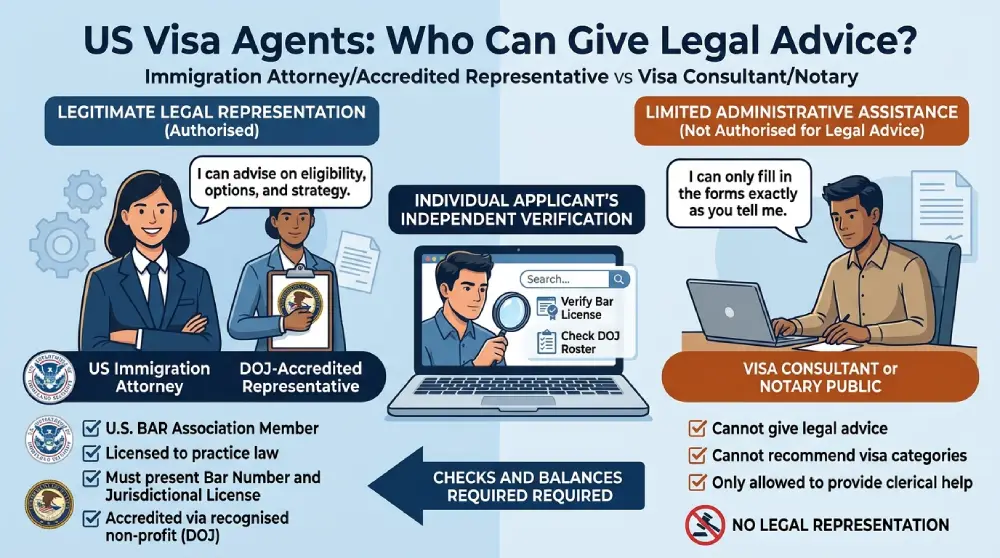
“Visa agent” and “US visa consultant” are service descriptions, not proof that someone can practice immigration law. Administrative assistance and legal representation are different: USCIS distinguishes limited form-filling help from advice about immigration options, which forms to file, and supporting evidence. Check the provider’s actual authorization, not just their title. (USCIS legal services guidance)
- Administrative helpers: May provide limited clerical assistance, such as entering answers supplied by the applicant; this does not authorize legal advice or representation, and applicable local rules matter. (USCIS)
- Immigration attorneys: U.S. attorneys representing applicants before USCIS must be eligible to practice and members in good standing of a qualifying U.S. bar, without disqualifying restrictions. (USCIS)
- DOJ-accredited representatives: Qualified nonlawyers who provide authorized immigration representation through DOJ-recognized nonprofit organizations, not independent commercial consultancies. (DOJ accreditation FAQs)
- Consular officers: Government officials who determine visa eligibility; a private consultant does not make that decision. (Department of State)
DOJ accreditation also has limits: partial accreditation covers DHS matters, including USCIS, while full accreditation additionally covers immigration courts and the Board of Immigration Appeals. It is not a blanket license for every immigration-related service. (DOJ accreditation FAQs)
There are limited additional representation categories, including supervised law students and qualifying foreign attorneys handling matters outside the United States. Applicants overseas should therefore check the rules for the specific proceeding rather than assume that every foreign lawyer is unauthorized or every locally registered consultant is qualified. (USCIS)
How can you verify US Visa Agents before paying?
Start by establishing whether the provider offers administrative work or immigration legal advice. Then verify any claimed professional authority independently, confirm the application route through government instructions, and get an itemized agreement before paying. Treat registration certificates, reviews, and office photographs as background information, not substitutes for these checks.
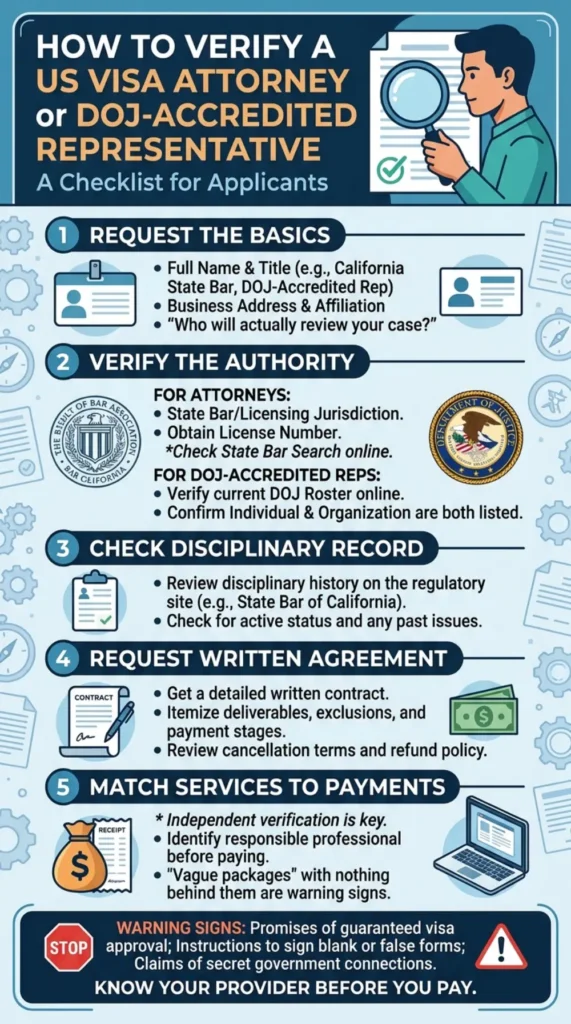
- Identify the responsible person. Request their full name, business address, and precise role. If a salesperson mentions an affiliated lawyer, ask who will actually review your case.
- Check an attorney’s licensing authority. Obtain the licensing jurisdiction and bar number, then verify eligibility to practice with that jurisdiction’s regulator, as USCIS recommends. (USCIS)
- Read the disciplinary record. For example, California’s official attorney-search resource provides license status and disciplinary and administrative history. (State Bar of California)
- Verify accreditation and affiliation together. Consult DOJ’s current rosters, checking both the individual and recognized organization; accreditation does not transfer automatically when someone leaves that organization. (DOJ program, DOJ FAQs)
- Confirm identity independently. Contact the professional through independently obtained details to check that the person messaging you really works there.
- Match the service to a written agreement. Ask for deliverables, exclusions, payment stages, cancellation terms, and a refund policy.
Imagine an agent advertising “lawyer-supervised processing” but refusing to name the lawyer. That leaves you unable to verify the most important claim; pause payment until the responsible professional and their involvement are clear.
What should you ask before paying for visa assistance?
Make the provider explain the work in ordinary language. These questions help distinguish a defined service from a vague package:
- Scope: “Are you typing my answers, translating documents, or advising on eligibility?”
- Responsibility: “Who checks the completed application, and can I review it before submission?”
- Charges: “Which payments are government fees, and which are your private service charges?”
- Records: “Will I receive application copies, confirmations, receipts, and submitted documents?”
- Refunds: “What happens if I cancel, appointments are unavailable, or my application is refused?”
- Data security: “How will you store my documents, and when will you delete them?”
Compare visa consultancy services by these answers, not just their headline prices. Keep a personal record of what was promised and what you approved.
What can legitimate visa documentation assistance include?
Limited administrative help can include typing information you provide or translating what you ask someone to translate; deciding which immigration benefit to pursue or what answers to give crosses into legal advice. For USCIS forms, unauthorized helpers are limited to permitted assistance and nominal fees, subject to relevant rules. (USCIS, FTC)
For the DS-160, follow the Department of State’s third-party assistance instructions, identify assistance as required, and generally sign the application yourself; specific exceptions cover certain minors and applicants unable to complete it. Your signature certifies that you understand the questions and that the answers are truthful. (DS-160 FAQs)
When reviewing visa application forms, check for common visa application mistakes: incorrect passport numbers, inaccurate travel history, missing answers, and information entered without your approval. Inaccurate or incomplete DS-160 answers can require corrections and rescheduling; false or misleading statements can have much more serious consequences. (DS-160 FAQs)
How do official requirements, fees, and work visas fit together?
Start with the official page for your travel purpose, then follow the relevant embassy’s instructions. For a visitor visa, the process generally includes the DS-160, applicable fee payment, appointment arrangements, and an interview unless an exception applies; local procedures and the order of steps can differ. (Department of State visitor visa guidance)
Visa eligibility requirements are category-specific, not satisfied merely by assembling a thick folder. For visitor visas, officials may seek evidence of your travel purpose, ability to pay, and intention to depart; an invitation letter is not required or a deciding factor. (Department of State)
Check passport requirements too: visitor applicants generally need validity extending at least six months beyond their intended stay, unless a country-specific agreement provides an exception. Do not accept an agent’s universal “six-month rule” without checking the applicable instructions. (Department of State)
Work visas require particular care because the correct category depends on the planned employment, and many temporary-worker routes require an employer petition approved by USCIS before the visa application. Petition approval still does not guarantee visa issuance. (Department of State temporary worker guidance)
For costs, distinguish private charges from official fees: the published visitor-visa application fee is $185 and is nonrefundable, while other categories and additional applicable charges differ. Recheck the current fee schedule and embassy payment instructions before transferring money. (Department of State visitor guidance, official fee schedule)
Which promises should make you stop?
Guaranteed visa approval is not a service anyone can legitimately sell. A consular officer decides whether you qualify, and the Department of State explicitly warns that visa issuance is not guaranteed. (Department of State)
Other warning signs include instructions to sign blank forms, invent employment, alter financial records, or conceal facts; the FTC warns against signing false or blank immigration forms. Willful material misrepresentation or fraud can result in permanent visa refusal or denial of entry. (FTC, Department of State)
Promises to eliminate visa processing delays deserve a separate check. Appointment estimates are not guarantees, and they exclude administrative processing, whose duration depends on the case. (Department of State wait-time guidance)
Do not assume every paid expedited appointment is fraudulent: as of November 6, 2026, an official pilot at selected posts offers eligible B-visa applicants an optional $750 expedited appointment through December 31, 2026, subject to availability. That buys an earlier interview, not guaranteed issuance or faster adjudication; verify availability directly through official instructions rather than an agent’s “special access” claim. (Department of State pilot announcement)
What if an agent takes your money or submits false information?
Stop further payments while you investigate, preserve messages and receipts, and ask your payment provider whether recovery is possible. Separately, seek qualified immigration advice promptly if inaccurate information was filed: recovering money and addressing an application record are different problems.
Report immigration scams through the FTC’s reporting route or appropriate local authorities, and report U.S. visa-application fraud through the Department of State’s official reporting page. A fraud report is not a substitute for obtaining instructions about your application. (FTC, Department of State fraud reporting)
For DS-160 corrections, contact the embassy or consulate for case-specific next steps. Do not assume a consultant can quietly overwrite everything after submission. (DS-160 FAQs)
Frequently asked questions
Is a US visa consultant the same as an immigration lawyer?
No. A consultant’s title does not establish authority to provide immigration legal advice, while eligible attorneys and DOJ-accredited representatives have defined authorization. (USCIS) Ask what credential the person holds and verify it independently before relying on their legal recommendations.
How much do US visa agents charge?
Separate the proposed private service charge from government fees, which depend on the visa category. (Department of State fee schedule) Request an itemized quote rather than comparing bundled totals; also remember that USCIS restricts unauthorized helpers to limited assistance and nominal fees. (USCIS)
Can a visa agent complete my DS-160 application?
Third-party help is addressed in the DS-160 instructions, but assistance does not remove your responsibility for truthful answers or the applicable signature requirements. (Department of State DS-160 FAQs) Review every answer before submission, follow the preparer-disclosure instructions, and keep your confirmation page.
Can a consultant speed up US visa processing or guarantee approval?
No consultant controls a consular officer’s eligibility decision, and interview wait estimates exclude case-dependent administrative processing. (Department of State visitor guidance, wait-time guidance) Ask whether a promised deadline concerns preparing documents, obtaining an appointment, or actual government adjudication; those are different milestones.
How can I verify an immigration attorney is licensed?
Ask for the attorney’s full name and licensing jurisdiction, then check eligibility directly with that jurisdiction’s regulatory agency, rather than relying on a certificate supplied by the provider. (USCIS) Review available disciplinary information too; California’s official search is one example of a regulator providing those records. (State Bar of California)
What should I do if a visa agent scams me?
Keep evidence, stop sending money, and investigate payment-recovery options. Report the scam using the FTC or relevant local channels and use the State Department’s reporting route for visa fraud; seek separate qualified advice if your application contains false information. (FTC, Department of State)
Before you hand over a dollar
A useful provider should leave you understanding more, not depending on secret connections or unexplained charges. Verify credentials, read the agreement, separate official fees from private charges, and refuse approval guarantees.
Keep the official instructions as your independent reference throughout the process. Before paying anyone, make sure you can explain what they will do, what they cannot do, and how you will retain access to your application records.
Authoritative references
- U.S. Citizenship and Immigration Services: Find Legal Services.
- U.S. Department of Justice, Executive Office for Immigration Review: Recognition & Accreditation (R&A) Program.
- U.S. Department of Justice, Executive Office for Immigration Review: Recognition and Accreditation Program Frequently Asked Questions.
- State Bar of California: Find Legal Professionals.
- Federal Trade Commission: How To Avoid Immigration Scams and Get Real Help.
- U.S. Department of State: DS-160: Frequently Asked Questions.
- U.S. Department of State: Visitor Visa.
- U.S. Department of State: Temporary Worker Visas.
- U.S. Department of State: Fees for Visa Services.
- U.S. Department of State: Visa Appointment Wait Times.
- U.S. Department of State: Nonimmigrant Visa Expedited Appointment Pilot Program.
- U.S. Department of State: Reporting U.S. Passport or Visa Fraud.